Contact Us

Treasury Management: SinglePoint Cash and Liquidity Tools for American Corporates

SinglePoint treasury management turns dozens of operating accounts into a single concentrated position. Zero-Balance Accounts, automated sweep, positive pay with payee match, wholesale and retail lockbox, controlled disbursement and intercompany netting all live inside one authenticated commercial portal.

This is treasury for organisations processing $25M to $5B+ in annual American payment volume. SinglePoint integrates directly with SAP, Oracle, Kyriba and ION via native BAI2 and MT940 feeds. Operating oversight sits inside the OCC-regulated U.S. Bank national bank charter.

Speak to a Treasury Advisor See Operating Accounts
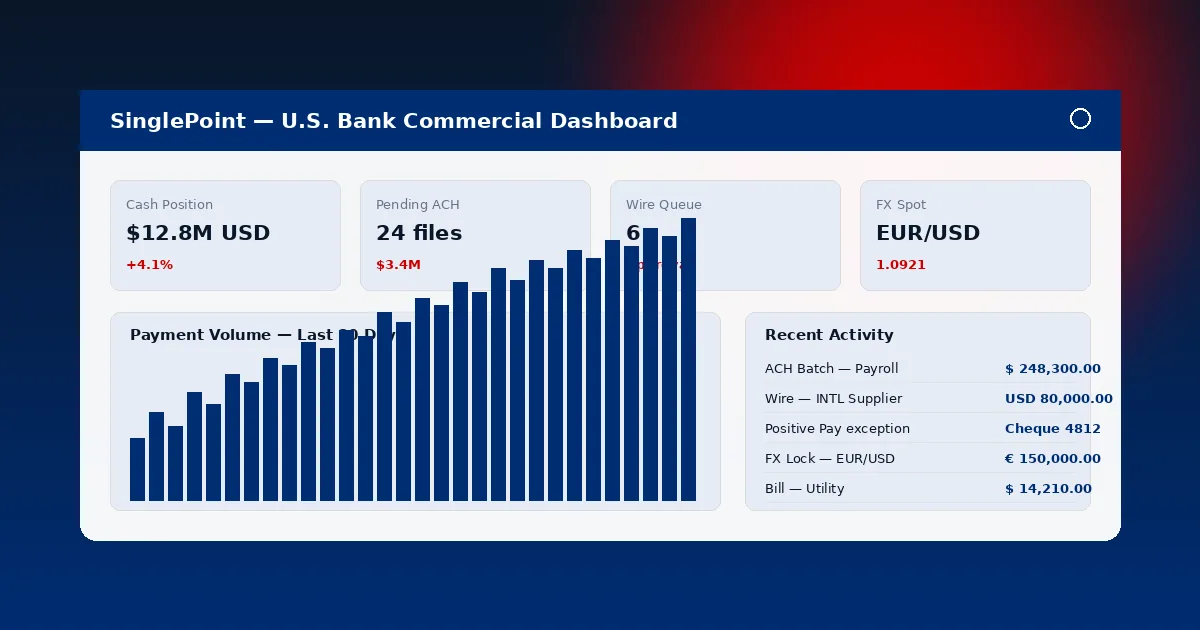
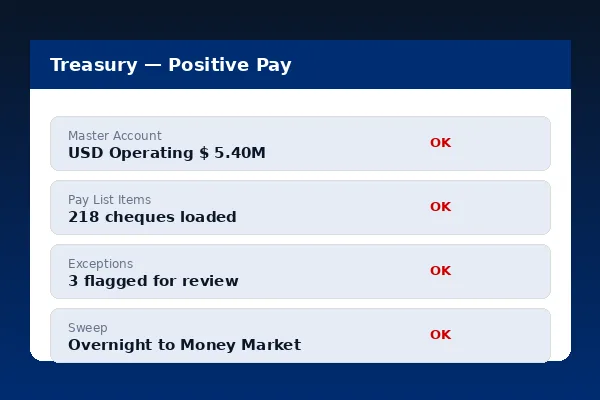
SinglePoint treasury dashboard showing ZBA hierarchy, positive pay exception queue and controlled disbursement position

Seven Pillars of SinglePoint Treasury Management

Each tool stands alone; deployed together they form the concentration, fraud-prevention and reporting spine of American corporate treasury.

Zero-Balance Accounts (ZBA)

Operating sub-accounts that hold zero end-of-day ledger balance. Deposits sweep up to the concentration account nightly; outgoing disbursements draw down from concentration on demand. SinglePoint ZBAs give treasury a single investable cash position at the concentration level instead of fragmented balances across payroll, AP, AR and department sub-accounts.

Automated Sweep Arrangements

Overnight sweep from checking to SinglePoint money market, investment sweep to U.S. Bank managed portfolios, and loan sweep that pays down revolving credit balances automatically from excess cash. Sweep type, target balance and direction are all configured inside SinglePoint with approvals routed to the Company Administrator.

Positive Pay (Check + Payee Match)

Fraud prevention for paper disbursement. SinglePoint compares presented items against an issued-items file the company uploads at cheque print. Standard positive pay checks serial + amount; payee-match positive pay extracts the payee line via OCR and flags any alteration. Exceptions appear in the SinglePoint queue by 10am CT.

Lockbox (Wholesale + Retail)

Wholesale lockbox handles low-volume, high-value B2B receipts with detailed remittance capture and image archive. Retail lockbox processes high-volume consumer receipts via OCR scanline extraction. Both feed SinglePoint reporting and your AR system in real time. U.S. Bank processing centres in Minneapolis, St. Louis and Atlanta run the physical operations.

Account Reconciliation Services

Full or partial reconciliation support. Full recon matches every issued item to every paid item, flags outstandings and uncleared presentments, and produces month-end ready reports directly inside SinglePoint. Partial recon provides a paid-only listing and leaves the matching logic with the client. Both export to BAI2/MT940.

Controlled Disbursement

Disbursement account type that reports total presentments by 11am CT on the day of clearing, letting treasury fund exactly what is needed with no end-of-day idle balance. Paper and ACH debits clear against controlled disbursement; concentration funds transfer in after the presentment figure is known. Standard in mature corporate cash structures inside SinglePoint.

Intercompany Netting & In-House Bank

For multi-entity groups, SinglePoint supports intercompany netting where sibling-entity receivables and payables are matched and settled net rather than gross — reducing wire volume, FX volume and interest-bearing intercompany balances. In-house bank structures (where the concentration entity acts as internal banker to subsidiaries) are supported with full audit trail.

Target Balance Accounts

Hybrid of ZBA and traditional operating account. Maintains a configured target balance overnight (e.g. $500K USD) rather than zero. Suitable for operating accounts with FX settlement or certain regulatory minimum-balance requirements where true ZBA would interfere. Fully supported inside SinglePoint with automatic true-up to target at Fed close.

SinglePoint Treasury Tool Matrix

Tool, function, risk mitigated and ROI lever for each of the seven SinglePoint treasury pillars.

ToolFunctionRisk MitigatedROI Lever
Zero-Balance Accounts (ZBA)Auto-sweep to concentration nightlyFragmented idle balancesConcentrated investable cash
Automated SweepExcess to money market, deficit to credit lineZero-yield operating cashOvernight yield on excess; interest savings on credit
Positive Pay + Payee MatchMatch presented items to issued fileCheque fraud, altered payeeFraud loss reduction, insurance premium rebate
Lockbox (Wholesale + Retail)Outsourced receipt processing & captureCheque float, AR posting delayDSO reduction, AP headcount rebalance
Account ReconciliationIssued-vs-paid matching with exception reportsManual month-end errorController hours saved, audit trail
Controlled Disbursement11am CT presentment reportOver-funded idle disbursementMax concentration balance, min idle float
Intercompany NettingGross-to-net multilateral settlementExcess wire + FX volume, inter-entity interestWire fee reduction, FX spread, reduced balances

How SinglePoint Treasury Integrates with ERP and Treasury Workstations

Native BAI2/MT940, SFTP delivery, API pull and format mapping for the major American corporate ERP footprint.

BAI2, MT940 and the Intraday vs Prior-Day Handshake

SinglePoint publishes two classes of bank-reporting file: prior-day and intraday. Prior-day BAI2 arrives by 6am CT for the prior business day, capturing every posted transaction with end-of-day balance. Intraday BAI2 refreshes every 15 minutes during the American business day, so treasury workstations (Kyriba, ION Openlink, GTreasury) can run accurate intraday cash position, FX hedging and funding calculations.

MT940 is the SWIFT statement standard — widely used by non-American subsidiaries and multinational treasury workstations. SinglePoint publishes MT940 with full field compatibility including field 61 statement lines and field 86 narrative. MT942 intraday statements follow the same cadence as intraday BAI2.
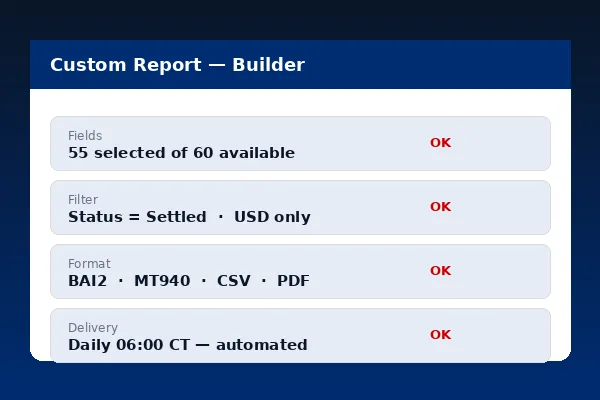
SinglePoint BAI2 file sample showing prior-day statement with summary record and transaction detail lines
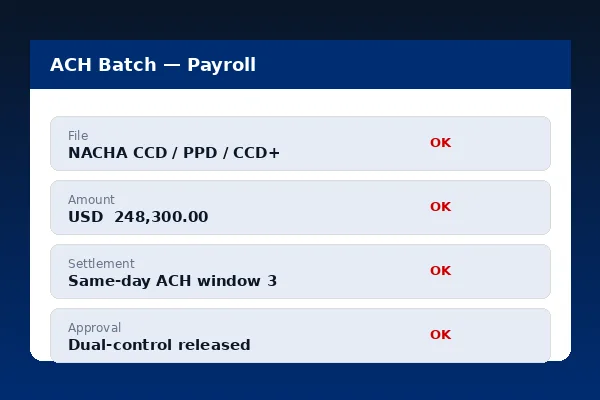
SinglePoint ERP connector diagram showing SFTP, API and scheduled delivery paths to SAP, Oracle and NetSuite

ERP and TMS Connector Support

Direct connectors cover SAP (via S/4HANA Cash Management and BCM), Oracle ERP Cloud and EBS (via Cash Management module), NetSuite (via Bank Feeds SuiteApp), Workday (via Bank Statement Import), Microsoft Dynamics 365 Finance, Sage Intacct and QuickBooks Online. Each connector maps SinglePoint account numbers to ERP cash GL accounts, translates BAI2 transaction codes into ERP transaction types, and automates daily posting.

Treasury workstations consume SinglePoint feeds for pooling, forecasting, FX exposure management and intercompany position. Kyriba and ION each publish pre-built SinglePoint adaptors. For internally developed treasury tools, the SinglePoint API exposes authenticated endpoints for balance query, transaction history, payment initiation and reporting retrieval.

Intercompany Netting: Gross to Net in Practice

A multi-entity group with 14 subsidiaries and 86 intercompany trade lanes runs the netting cycle weekly inside SinglePoint. Gross intercompany settlements for one weekly cycle: $47M USD across 86 wires and 23 FX conversions. Netted: one sub-entity is $3.2M USD net payer, three others are net receivers at $1.1M, $0.9M and $1.2M USD respectively. Net settlement: 4 wires, 1 FX conversion.

The SinglePoint netting centre processes the matching, handles the multi-currency translation at the netting-cycle reference rate, produces the net-position statements per entity and issues the settlement instructions. Treasury approves the cycle; SinglePoint executes the 4 net wires. Weekly savings on a representative group: $17,400 USD in wire fees, $62,000 USD in FX spread, and 40-60% reduction in intercompany balance carry.

SinglePoint intercompany netting cycle diagram showing 14 entities pre-net and 4 net settlements post-cycle

Positive Pay, Controlled Disbursement and the American Fraud Floor

Fraud remains the single largest operational risk in American corporate AP. SinglePoint treasury tools harden the paper and ACH rails.

Treasury Brief

  • SinglePoint positive pay matches every presented cheque against the issued-items file before payment.
  • Payee-match positive pay extracts payee line via OCR and flags alteration of the payee name.
  • Controlled disbursement reports presentment by 11am CT to minimise end-of-day idle funding.
  • ACH positive pay applies the same principle to ACH debits with debit-blocker rules.
  • Consumer fraud protections supervised by the CFPB do not apply to business accounts — treasury controls are the first line.

Positive Pay Exception Workflow

Presented items reach SinglePoint by 10am CT. Exceptions (serial mismatch, amount mismatch, stale-date, payee-match failure) queue in the treasury workbench. Reviewer pays or returns each exception before 2pm CT. Any unactioned exception reverts to the pay/return default configured at setup. Full audit trail of every decision.

ACH Positive Pay and Debit Blocker

ACH debit fraud follows the same logic. SinglePoint ACH positive pay rules authorise approved originators by company-ID and maximum amount. Any unauthorised originator is returned R29 at the ODFI. Debit-blocker mode refuses all ACH debits on designated accounts — common on payroll-funding and tax accounts.

Controlled Disbursement Funding Math

Historical example: a $50M USD AP operation maintains $2.5M USD average idle balance in a standard disbursement account. Converting to SinglePoint controlled disbursement with 11am CT presentment reporting cuts idle balance to $150K USD average. On a 5% overnight yield environment, that is $117,500 USD per year in recaptured yield.

Treasury management is where SinglePoint earns its monthly fee on analysis billing. Each ZBA reduces idle balance; each positive pay exception intercepts a potential loss; each controlled disbursement presentment cycle tightens funding discipline by several hours. Aggregate ROI on a well-configured SinglePoint treasury programme routinely runs in the low-to-mid six figures annually for middle-market corporates and into seven figures for large enterprise groups with multi-entity complexity. The question is not whether to deploy these tools — it is whether your current bank offers them with the same configuration depth and ERP compatibility as SinglePoint.

People Also Ask About SinglePoint Treasury Management

What is a Zero-Balance Account inside SinglePoint?
An operating sub-account configured to hold zero end-of-day balance. Deposits sweep up to concentration; disbursements draw down on demand. ZBAs let treasury run a single investable balance rather than fragmented sub-account balances inside SinglePoint.
How does SinglePoint positive pay prevent cheque fraud?
Every presented cheque matches against an issued-items file for serial, amount, date and payee name. Mismatches queue as exceptions by 10am CT for treasury to pay or return before 2pm CT.
What is the difference between wholesale and retail lockbox in SinglePoint?
Wholesale handles low-volume, high-value B2B with detailed remittance capture. Retail handles high-volume, low-value consumer receipts with OCR scanline. Both feed SinglePoint reporting and AR systems directly.
Which ERP systems integrate with SinglePoint treasury reporting?
SAP, Oracle ERP Cloud and EBS, NetSuite, Workday, Dynamics 365, Sage Intacct, QuickBooks. Treasury workstations: Kyriba, ION (Reval, Openlink), GTreasury, Coupa, FIS Quantum. BAI2, MT940 and CSV supported.
What is controlled disbursement inside SinglePoint?
A disbursement account type that reports presentment totals by 11am CT on clearing day, letting treasury fund exactly what is needed after the presentment figure is known — minimising idle end-of-day balance.

Related SinglePoint Services

Treasury tools sit at the centre — they connect to every other SinglePoint capability.

Business Checking

The operating accounts that ZBAs sit atop and that feed the SinglePoint overnight sweep.

Business Savings

The money market sweep target and the CD laddering engine for long-dated operating reserves.

Foreign Exchange

Multi-currency settlement, FX hedging and intercompany netting FX translation.

ACH Payments

ACH origination and the debit-block/positive-pay ACH fraud controls.

Wire Transfers

Fedwire and SWIFT wires through the controlled disbursement and concentration accounts.

Transaction Reporting

The 60-field report engine and BAI2/MT940 delivery that every treasury tool feeds into.

Commercial Banking Portal — Topic Cluster