Contact Us

Business Credit Cards: SinglePoint Card Programme Administration

SinglePoint card programme administration centralises employee card issuance, MCC restriction, virtual-card generation for AP, expense routing to Concur/Coupa/Expensify and T&E policy enforcement — all against a portfolio of six U.S. Bank business card products. One dashboard. One admin. One consolidated view of corporate card spend.

Cards are the most granular payment rail — the one where the employee is the authoriser and the corporate controls sit in the administrative overlay. SinglePoint is where those administrative controls live. PCI-DSS compliance governs the cardholder-data handling footprint; consumer-credit rules are supervised by the CFPB on consumer products, while commercial card administration falls outside that perimeter.

Request a Card Programme Review See Operating Accounts
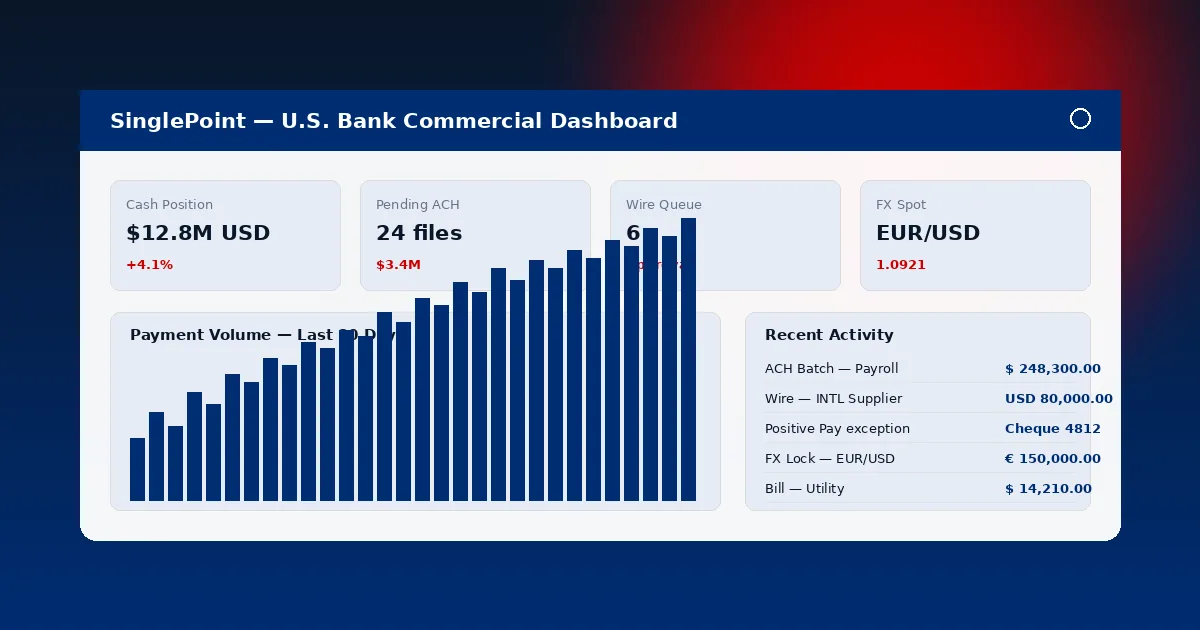
SinglePoint card programme administration dashboard showing employee cardholder list MCC controls and virtual card queue

Six U.S. Bank Card Products Inside the SinglePoint Portfolio

Each product is designed for a distinct corporate profile — from startup cash-rewards to enterprise T&E central billing.

U.S. Bank Business Platinum Card

Zero introductory APR for the first 15 billing cycles on purchases and balance transfers. No annual fee. Suitable for small businesses managing working-capital gaps through the introductory window. Integrates with SinglePoint for real-time expense capture, employee sub-card issuance and MCC controls. Individual or corporate liability at client election.

Business Altitude Connect

Travel-rewards oriented card with 4x points on travel (airlines, hotels, car hire, transit), 2x on dining and gas, 1x on everything else. Annual fee offset by travel credits on qualifying volume. Travel insurance, lost-luggage reimbursement and trip-interruption coverage included. Managed inside SinglePoint alongside corporate T&E policy enforcement.

Business Cash Rewards

Cash-back for operators without meaningful travel spend. 3% back on two top categories of the cardholder's choice (office supplies, gas, cell, internet, restaurants, shipping), 1% on everything else. Cash back redeems as statement credit or direct deposit to a linked SinglePoint operating account.

U.S. Bank Corporate Card Programme

Full enterprise corporate-card programme for middle-market and large-corporate deployments. Central billing with consolidated monthly statement. Flexible credit limits per cardholder. Level 2 and Level 3 data capture on qualifying transactions (invoice number, ship-to, line items). Custom MCC templates. Managed entirely through SinglePoint with multi-admin support.

Freedom Business

Flat 1.5% cash-back on every purchase with no category complexity — the right choice for organisations that value administrative simplicity over category optimisation. No annual fee. Unlimited employee cards. Integrates with SinglePoint for standard expense data export and cardholder management.

U.S. Bank Leverage Visa Business

High credit-limit card for established middle-market businesses with strong American banking relationships. Tiered rewards structure with bonus categories adjusted quarterly. Travel and purchase protections. Entry-level to the corporate-card programme — often the first step before transitioning to the full Corporate Card programme inside SinglePoint.

SinglePoint Business Card Portfolio Matrix

Card, annual fee, reward type, best-fit organisation and liability model across the six SinglePoint-integrated U.S. Bank business cards.

CardAnnual FeeReward TypeBest ForLiability Model
U.S. Bank Business Platinum Card$0 USDZero intro APR (15 cycles)Working-capital gap bridgingIndividual or corporate
Business Altitude Connect$95 USD (waived year one)4x travel, 2x dining/gasTravel-heavy employees & teamsCorporate with individual tracking
Business Cash Rewards$0 USD3% top-2 categories, 1% otherSmall ops without travel spendIndividual or corporate
U.S. Bank Corporate Card programmeProgramme pricingVolume rebate per tierEnterprise T&E & APCentral billing (corporate)
Freedom Business$0 USDFlat 1.5% on everythingAdmin-simplicity over optimisationIndividual or corporate

How SinglePoint Card Programme Administration Actually Works

Card issuance, MCC rule engine, virtual-card AP workflow and expense routing across Concur, Coupa and Expensify.

Employee Card Issuance and Instant Activation

Inside SinglePoint, the Company Administrator requests an employee card with employee name, role, cost centre, initial credit limit, MCC template and liability model (corporate or individual). Physical cards ship within 5 business days; virtual credentials activate instantly for in-app use with Apple Pay and Google Pay wallets. Card deactivation on employee departure is a single-click action inside SinglePoint — no call to card services.

Sub-admin roles allow department heads to issue cards within their own cost-centre scope without full programme administration rights. For large enterprise deployments with 500+ cardholders, the SinglePoint API supports bulk issuance via HR-system integration — employee onboarding in Workday or SuccessFactors automatically triggers card creation; employee offboarding triggers card deactivation.
SinglePoint employee card issuance workflow with cost centre initial limit and MCC template selection form
SinglePoint MCC rule engine showing travel only template with airline lodging transportation code ranges allowed

MCC Controls and Policy Enforcement

Merchant Category Codes (MCCs) are the Visa/Mastercard classification applied to every transaction at authorisation. SinglePoint exposes MCC controls at three scope levels: per cardholder, per card-product template, or globally across the programme. A travel-only card template allows MCCs 3000-3999 (airlines), 3500-3999 (lodging), 4111-4789 (transportation) and declines everything else at authorisation.

Softer controls use alert-only mode: the transaction authorises but routes an alert to the administrator inside SinglePoint. This is useful for fuzzy-policy enforcement where the cardholder has discretion but compliance wants visibility. Daily spend limits, monthly spend limits, single-transaction limits and geographic restrictions all compose with MCC rules inside the SinglePoint rule engine.

Virtual Cards for AP and Supplier Payments

Virtual cards are single-use or limited-use card numbers generated on-demand inside SinglePoint for supplier payment. Each virtual card carries a unique PAN, an authorisation limit matched to the invoice amount, a validity window of typically 7-30 days, and optionally an MCC restriction matching the supplier category. The supplier processes the virtual card through their normal card acquirer; the authorised amount posts against the corporate account.

Rebate economics matter: interchange-share rebates on virtual card volume routinely run 0.75-1.25% on qualifying spend, making virtual cards cost-positive on suppliers who previously accepted paper cheque or ACH. For a $10M USD annual AP shift from cheque to virtual card, the rebate alone is $75,000-$125,000 USD per year. SinglePoint tracks virtual-card authorisation, post-auth reconciliation and rebate accrual against the linked operating account.

SinglePoint virtual card generation screen showing supplier name invoice amount validity window and MCC restriction

Expense Routing to Concur, Coupa and Expensify

How SinglePoint card data flows into the expense system of record.

Card Programme Profile

  • Six U.S. Bank business card products all integrate with SinglePoint for real-time expense data.
  • MCC controls apply per cardholder, per product template, or globally across the programme.
  • Virtual cards for AP generate on-demand with unique PAN, auth limit and MCC restriction.
  • Native expense-system integration: SAP Concur, Coupa Expense, Expensify; CSV to Workday, NetSuite, Dynamics.
  • Central billing consolidates employee spend against a single SinglePoint operating account.

SAP Concur Native Integration

Nightly transaction feed with Level 2 and Level 3 data where available. Automatic cardholder matching by employee ID. Transaction receipts attached via Concur mobile app; SinglePoint transaction enrichment (merchant name, geolocation, tax components) carries through to the expense report. Approval routing stays inside Concur with SinglePoint as the authoritative settlement system.

Coupa Expense and AP Integration

Coupa Expense consumes the SinglePoint transaction feed with unified master data on suppliers — so a virtual-card payment to a Coupa-managed supplier automatically reconciles against the originating PO and invoice. Card-statement-to-AP matching happens automatically inside Coupa with SinglePoint as the settlement rail.

Expensify for SMB Ops

Expensify is the common choice for SMB organisations under 100 cardholders. SinglePoint posts transactions into Expensify within hours of authorisation. Smart-scan receipt matching, policy-rule enforcement and approval workflow all run inside Expensify. Reimbursement cycle for individual-liability cards closes through Expensify ACH back to the employee.

The value of a SinglePoint-administered card programme is not the rewards — it is the administrative overlay. Centralised issuance, MCC-level policy enforcement, virtual cards displacing cheque AP, Level 2/3 data capture flowing into Concur/Coupa/Expensify, instant deactivation on offboarding. These are the controls CFOs pay for and auditors verify. Rewards are the consolation prize — real, meaningful, but not the primary ROI. PCI-DSS compliance boundaries, SOX-relevant internal controls and Sarbanes-Oxley segregation of duties all rest on the quality of the card-programme administration, and SinglePoint is where that quality lives for U.S. Bank commercial clients.

People Also Ask About SinglePoint Business Credit Cards

Which U.S. Bank business credit cards integrate with SinglePoint?
Business Platinum, Altitude Connect, Cash Rewards, Corporate Card programme, Freedom Business and Leverage Visa Business. All six support real-time transaction streaming, MCC controls, employee issuance and expense-system integration inside SinglePoint.
What is the difference between central billing and individual liability in SinglePoint?
Central billing: the corporate is liable; consolidated balance paid from SinglePoint operating account. Individual liability: each employee is personally liable; expense reimbursement. Hybrid mode also supported.
How do virtual cards for AP work inside SinglePoint?
Single-use or limited-use card numbers generated on-demand with unique PAN, auth limit, validity window and optional MCC restriction. Rebate income applies as interchange-share on qualifying volume.
Can SinglePoint enforce T&E policy through MCC controls?
Yes. MCC restrictions apply per cardholder, per product template or globally. Declines out-of-policy transactions at authorisation. Soft-alert mode routes alerts to the administrator without declining.
Which expense platforms integrate with SinglePoint business cards?
Native: SAP Concur, Coupa Expense, Expensify. CSV export maps to Workday Expense, NetSuite Expenses, Microsoft Dynamics 365 Expense Management.

Related SinglePoint Services

Cards integrate with operating accounts, AP, credit lines and reporting across SinglePoint.

Business Checking

Card settlement direct to SinglePoint operating accounts with same-entity accounting.

Business Loans

Revolving credit lines as backup to card limits for large capital expenditure episodes.

Vendor Payments

Virtual-card AP for suppliers replacing paper cheque and ACH with rebate-positive card spend.

Treasury Management

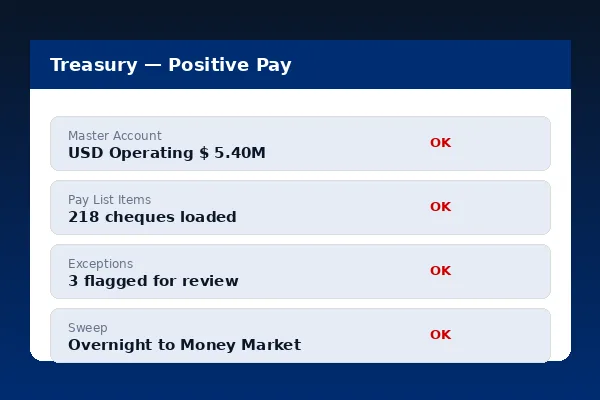
Card statement consolidation with SinglePoint cash position and funding forecast.

ACH Payments

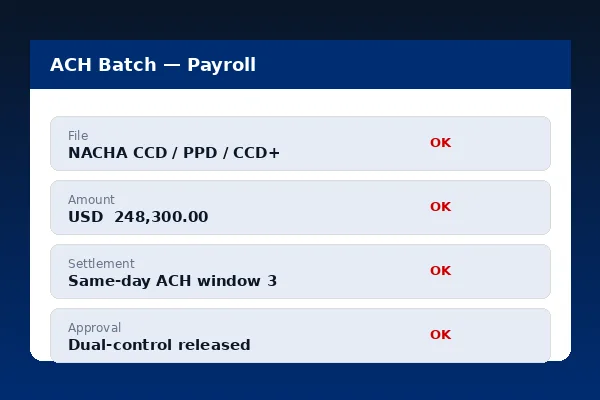
ACH payment-in for central-billing statements settling directly from a linked operating DDA.

Transaction Reporting

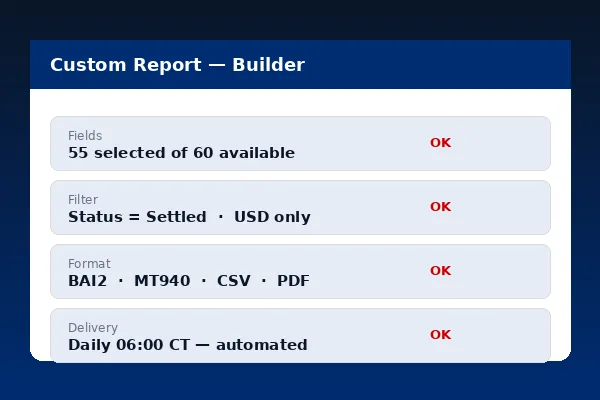
60-field reports on cardholder spend, MCC breakdown, cost centre analysis and rebate accrual.

Commercial Banking Portal — Topic Cluster