Contact Us

Business Savings and CDs: SinglePoint Yield Accounts for Idle Operating Cash

SinglePoint yield accounts turn idle checking cash into interest — Business High-Yield Savings for liquid reserves, Business Money Market Account as the default sweep target, and a CD ladder across six terms from 3 months to 60 months. All FDIC-insured, all manageable inside one SinglePoint dashboard.

Treasury teams using SinglePoint rarely let more than the operating target sit in a non-yielding checking account. The overnight sweep, the CD ladder and the money market tier structure are the three levers that move excess operating cash into yield without sacrificing liquidity. Deposit insurance limits and ownership-category rules are set by the FDIC.

Open a SinglePoint Savings Account See Checking Tiers
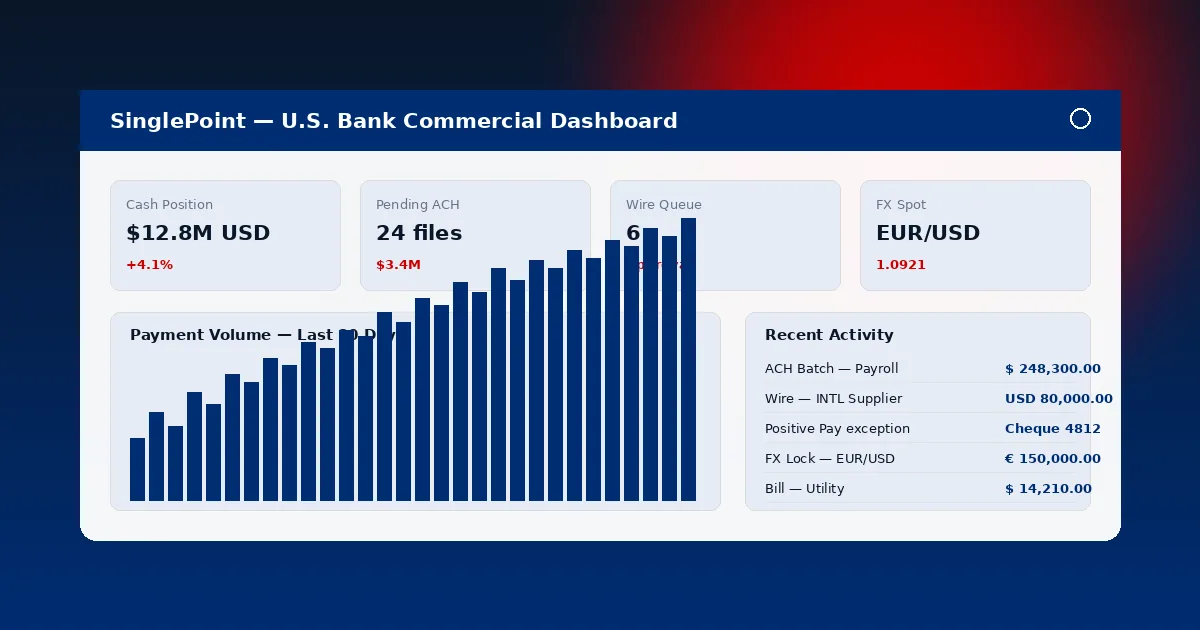
SinglePoint yield account dashboard with CD ladder timeline, money market balance and high-yield savings widgets

Three Product Families Inside SinglePoint Yield

Business High-Yield Savings, Business Money Market Account and Certificates of Deposit — the same FDIC coverage rules apply across all three, but the liquidity and yield profiles differ materially.

Business High-Yield Savings

Tiered-rate savings with no transaction fee for the first 6 withdrawals per statement cycle. Balances under $25,000 USD earn the base tier rate; balances $25,000-$250,000 USD earn the mid tier; balances above $250,000 USD earn the premium tier. Interest accrues daily, posts monthly. Linked to your SinglePoint checking for instant transfer. FDIC-insured to the standard $250,000 USD limit per ownership category.

Business Money Market Account

The default overnight sweep target inside SinglePoint. Tiered rates keyed to prevailing Fed funds, with premium tier above $500,000 USD. Cheque-writing is permitted (up to 6 pre-authorised transfers per cycle under historical Regulation D conventions, now retained as an operational default). The SinglePoint money market lives alongside checking and CDs in the same consolidated dashboard.

Certificates of Deposit (3-60 month terms)

Fixed-rate, fixed-term time deposits ranging from 3-month through 60-month maturities. Minimum $10,000 USD opening; promotional SinglePoint rates apply above $100,000 USD; jumbo rates apply above $1,000,000 USD. Early withdrawal penalty scales with term length. Interest options: compound monthly inside the CD, or post monthly to a linked SinglePoint checking account.

CDARS and ICS Programme Access

For balances above the $250,000 USD FDIC cap, SinglePoint clients access the CDARS (Certificate of Deposit Account Registry Service) and ICS (Insured Cash Sweep) networks. A $5M USD deposit is divided across partner FDIC banks in sub-$250K slices, preserving full FDIC coverage on the entire balance while retaining a single relationship inside SinglePoint. Only available to U.S. Bank commercial clients.

SinglePoint Yield Product Matrix

Product, term, minimum deposit, yield character and liquidity window across the SinglePoint yield shelf.

ProductTermMin DepositYield TypeLiquidity
Business High-Yield SavingsNo term$500 USDTiered variableDaily with 6-withdrawal limit per cycle
Business Money Market AccountNo term$2,500 USDTiered variable (Fed-linked)Daily with cheque option, 6 transfer cap
3-Month CD90 days$10,000 USDFixed simple interest90-day maturity, 90-day early penalty
12-Month CD365 days$10,000 USDFixed compound monthly12-month maturity, 180-day early penalty
36-Month CD1,095 days$10,000 USDFixed compound monthly36-month maturity, 270-day early penalty
60-Month CD1,825 days$10,000 USDFixed compound monthly60-month maturity, 365-day early penalty

CD Laddering Inside SinglePoint

A ladder beats a single term on blended yield and reinvestment risk. Here is the mechanics inside SinglePoint.

Why Ladder Rather Than Lock One Term

Locking a single 5-year CD captures the 60-month yield today but exposes the full principal to the reinvestment rate in year 5. A ladder splits a $600,000 USD reserve into six $100,000 USD tranches across 3, 6, 12, 24, 36 and 60 months. Every three or six months, one tranche matures — the principal either rolls into a fresh 60-month at the then-current SinglePoint rate, or transfers to operating checking if needed.

The blended yield of a ladder approaches the long-dated rate while keeping a steady cadence of maturity dates. When rates rise, new tranches renew at higher rates inside SinglePoint. When rates fall, the already-locked long tranches continue earning the higher prior rate. This is the classic case for laddering and it applies equally to treasury reserves and corporate working capital.
SinglePoint CD ladder timeline with six tranches showing 3, 6, 12, 24, 36 and 60 month maturity cadence
SinglePoint interest posting schedule showing monthly compound option versus linked checking payout

Interest Posting Schedule and Compound Mechanics

Interest accrues daily on every SinglePoint CD from the funding date. Posting behaviour is a client choice at opening: post monthly into the CD (compounds future monthly interest on the growing principal), or post monthly to a linked SinglePoint checking account (no compounding but immediate liquidity of the interest stream). Terms of 3 and 6 months default to simple-interest accrual without compounding unless held to maturity.

IRS Form 1099-INT is issued annually for interest paid on every SinglePoint yield account including CDs, high-yield savings and money market. Business entities should consult the IRS 1099-INT instructions for reporting treatment. Early withdrawal penalty amounts are deductible from interest income under current IRS rules.

Early Withdrawal Penalty Schedule

Breaking a SinglePoint CD before maturity is permitted but penalised. The penalty is a number of days of simple interest on the withdrawn principal, scaled to the original term length: 90 days for 3-6 month terms, 180 days for 7-12 months, 270 days for 13-36 months, 365 days for 37-60 months. Penalties apply to the withdrawn principal amount — partial withdrawals are permitted on certain SinglePoint CD varieties.

Where accrued interest at withdrawal is insufficient to cover the penalty amount, the shortfall reduces principal. This is federally required practice on all FDIC-insured time deposits and is not a SinglePoint-specific policy. Death, adjudicated incompetence or IRS levy waive early withdrawal penalties; document requirements are standard and provisioned through the SinglePoint service centre at 1-800-377-3404.

SinglePoint early withdrawal penalty matrix showing term brackets from 3 to 60 months with scaled interest day counts

Sweep Arrangements and FDIC Coverage Engineering

How the overnight sweep handshake with SinglePoint checking works, and how to engineer FDIC coverage above the $250,000 USD cap.

Yield Reference

  • SinglePoint overnight sweep moves excess checking balances to money market at end-of-day Fed close.
  • Reverse sweep restores target balance on the next business day if checking falls below floor.
  • FDIC coverage: $250,000 USD per depositor, per ownership category, per insured bank.
  • CDARS/ICS distribute above-cap balances across partner banks to preserve FDIC coverage.
  • CD interest posts monthly; early withdrawal penalty scales 90-365 days depending on term.

Sweep Handshake Mechanics

Configure target collected balance inside SinglePoint checking. At Fed close, balances above target sweep to the linked Business Money Market Account. Balances below target trigger reverse sweep the next business day. The sweep calculation runs on collected (not ledger) balance, so paper-cheque float does not accidentally trigger sweep.

Money Market Tier Structure

SinglePoint Business Money Market rates tier at $25K, $100K, $500K and $1M USD thresholds. The premium tier above $1M USD tracks closest to the prevailing Fed funds overnight rate. Review Federal Reserve open market operations for background on the benchmark rate.

FDIC Coverage Above $250K

CDARS and ICS networks split above-cap balances across partner FDIC banks in sub-$250K slices. A $3M USD deposit is placed in 12+ partner banks, each slice under the cap, each slice separately FDIC-insured. Client sees one consolidated balance inside SinglePoint.

The interplay of SinglePoint checking, money market and CDs lets treasury teams run a disciplined three-tier cash structure: Tier 1 operating cash in checking for daily payments, Tier 2 reserve in money market for monthly working-capital swings, Tier 3 long-dated cash in CD ladders for multi-year project funds. Every tier stays FDIC-insured through the CDARS/ICS overlay when balances exceed the cap. Every tier reports into the same SinglePoint consolidated dashboard for cash position and yield calculation.

People Also Ask About SinglePoint Yield Accounts

How much FDIC coverage applies to SinglePoint business savings?
$250,000 USD per depositor, per insured bank, per ownership category. A single legal entity with checking, savings, money market and CDs at U.S. Bank receives aggregate coverage of $250,000 across all deposits in the same ownership category. See the FDIC coverage rules.
What is CD laddering inside SinglePoint?
Splitting a lump sum across multiple CD terms (3, 6, 12, 24, 36, 60 months) so one tranche matures every quarter. The ladder blends higher long-dated yields with short-dated liquidity and minimises reinvestment-rate risk.
How is SinglePoint CD interest posted and taxed?
Interest accrues daily, posts monthly to the CD or to a linked SinglePoint checking. Form 1099-INT issued annually; consult the IRS on business interest reporting treatment.
Are there early withdrawal penalties on SinglePoint CDs?
Yes. 90 days of simple interest for 3-6 month terms; 180 days for 7-12 months; 270 days for 13-36 months; 365 days for 37-60 months. Penalty applies to withdrawn principal.
Can the SinglePoint money market be used as a sweep target?
Yes. It is the default overnight sweep target for excess checking balances. Sweep runs at Fed close; funds earn the prevailing money market tier rate and remain liquid for next-day reverse sweep.

Related SinglePoint Services

Yield accounts pair with checking, treasury tools, card card programmes and reporting inside SinglePoint.

Business Checking

Operating accounts that feed the overnight sweep and absorb the reverse sweep back from money market.

Treasury Management

ZBA, lockbox and positive pay layered onto SinglePoint checking for enterprise cash concentration.

Foreign Exchange

Convert idle foreign-currency balances into yield-bearing USD CDs via SinglePoint FX.

Business Loans

Use SinglePoint CDs as collateral for secured lines of credit at relationship pricing.

ACH Payments

Collect customer ACH debits directly into SinglePoint high-yield savings for interest-bearing receivables.

Transaction Reporting

60-field reports showing interest accrual, CD maturity schedule and money market tier movement.

Commercial Banking Portal — Topic Cluster